

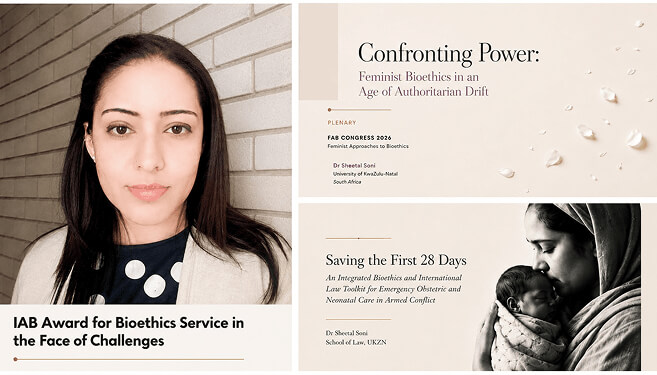
Dr Sheetal Soni, senior lecturer and Head of Research and Higher Degrees in UKZN’s School of Law, is the 2026 recipient of the International Association of Bioethics Award for Bioethics Service in the Face of Challenges.
The prestigious international award was presented at the World Congress of Bioethics in Johannesburg, and recognises individuals who have made outstanding contributions to bioethics under difficult or unfavourable circumstances. It honours those whose work extends beyond academic scholarship to advance bioethics in practice, mobilise knowledge into meaningful impact, and contribute to change at local, national or international levels.
The award places Soni among an international community of bioethicists recognised for translating ethical scholarship into meaningful action in challenging contexts.
The International Association of Bioethics (IAB) is the largest global scholarly and professional association bringing together bioethicists, researchers, clinicians, lawyers, philosophers, policymakers and practitioners from across disciplines and regions. Its World Congress of Bioethics provides a leading international platform for critical engagement with ethical questions shaping health, science, technology and society.
Recipients of the award are selected through a rigorous process. Candidates are nominated by members of the IAB and supported by three referees. Nominations are assessed by an awards committee, before recommended candidates are considered by the full IAB Board, which votes to determine the recipient.
Presenting the award, Professor Dorcas Kamuya described Soni as “an outstanding bioethicist whose work exemplifies the very spirit of this award reflecting a sustained commitment to advancing bioethics not only through scholarship, but through principled engagement in difficult, contested and often politically sensitive contexts”.
Kamuya highlighted Soni’s willingness to engage with ethically and legally urgent issues affecting vulnerable populations at a time when such engagement was neither widely embraced nor institutionally comfortable. She particularly acknowledged Soni’s early engagement with the plight of civilians in Gaza and the ethical implications of armed conflict, describing this work as demonstrating “a form of moral leadership that is both rare and commendable”. Kamuya also noted that Soni’s work had helped to open an important space within bioethics for engagement with conflict-related harms, particularly those affecting women, children and other vulnerable groups. Also recognised were her broader research contributions across reproductive ethics, emerging biotechnology, international law, and the ethical dimensions of health in crisis settings.
Reflecting on the award, Soni said: “I receive this recognition with deep gratitude and humility. Much of my work has emerged from a conviction that the realities around us cannot always be left outside our scholarship, and that bioethics must be willing to engage with difficult and ethically urgent questions, even when doing so is uncomfortable.” She added that one of the most meaningful aspects of the week was the opportunity to engage with scholars and practitioners from across the global bioethics community. “I was continually inspired by the depth, courage and importance of the work being undertaken across different disciplines, regions and contexts. Every contribution matters, and each brings something necessary to the larger work of advancing more ethical, just and humane societies. I am so grateful for the conversations and connections formed, and excited about the collaborations ahead and the important work that we will do together.”
Soni also thanked colleagues who nominated her; the IAB Awards Committee and Board; Dean and Head of UKZN’s School of Law, Professor Freddy Mnyongani for his continued support of her work, and to her colleagues and mentors whose scholarship, dedication and commitment to meaningful work have continually inspired and shaped her own. She also acknowledged her family, who have not only supported her work but have shared in the challenges that accompany sustained engagement with difficult and often distressing issues, as well as the many individuals and communities whose courage, experiences and work continue to inspire her.
“If my work can make even a small contribution to advancing more ethical, just and humane responses to the challenges confronting us, then it will have served its purpose,” said Soni.
The award marked the culmination of an exceptional week of international scholarly engagement for Soni.
She was invited to open the Feminist Approaches to Bioethics Congress and delivered a keynote address titled: ‘Confronting Power: Feminist Bioethics in an Age of Authoritarian Drift’, which considered the ethical implications of growing authoritarianism and reflected on the responsibility of feminist bioethics not only to analyse injustice, but also to name and confront it, while remaining attentive to the voices and experiences that structures of power too often render invisible.
At the World Congress of Bioethics, Soni presented her research paper: ‘Saving the First 28 Days: An Integrated Bioethics-International Law Toolkit for Emergency Obstetric and Neonatal Care in Armed Conflict’.
The paper brings bioethics and international law into conversation to examine how emergency obstetric and neonatal care can be better protected amid the profound disruption caused by armed conflict. It focuses particular attention on the protection of women and newborns during the critical first 28 days of life and proposes an integrated framework through which ethical and legal principles may be translated into practical protections in crisis settings. Soni has also been elected to the Board of Directors of the IAB, where she will serve a four-year term commencing in August 2026. As a member of the Board, she will contribute to the strategic direction and governance of the world’s largest professional association dedicated to bioethics and its global activities in advancing scholarship, collaboration and ethical engagement.
The recognition reflects the growing international reach and impact of scholarship emerging from UKZN’s School of Law and highlights the important contribution that interdisciplinary legal and bioethical research can make in responding to some of the most urgent ethical challenges facing contemporary society.
Words: NdabaOnline
Image: Supplied