

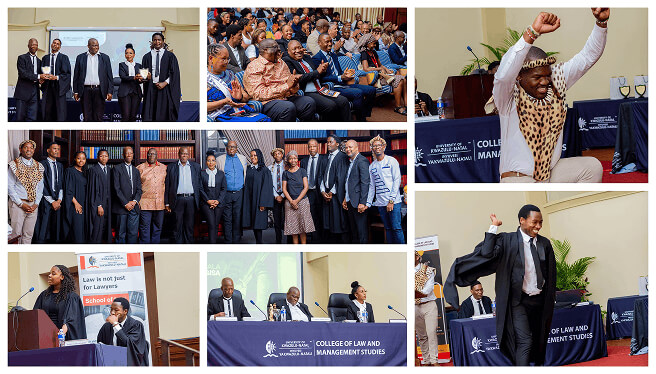
The University of KwaZulu-Natal’s (UKZN) School of Law has made a significant contribution to transforming legal education by hosting its first-ever isiZulu Moot Court Competition, demonstrating the power of indigenous languages in advancing legal reasoning and access to justice.
Held at the Howard College Theatre, the inaugural competition brought together aspiring legal practitioners, distinguished members of the judiciary and the legal profession to celebrate isiZulu as a language of legal scholarship, advocacy and professional practice.
The historic occasion coincided with the announcement of Dr Navanethem “Navi” Pillay as the 2026 Nobel Peace Prize Laureate, adding to the evening’s celebration of justice, human rights and the rule of law.
In his welcome address, Dean and Head of the School of Law, Professor Freddy Mnyongani, congratulated Pillay on the international recognition of her contribution to justice and accountability. Said Mnyongani: “For us at the University of KwaZulu-Natal, and particularly at the School of Law, her achievement is a source of immense pride. We celebrate not only the recognition bestowed upon her but also the values she represents and the example she sets for generations of Law students and legal practitioners. She has been a great pathfinder.”
Mnyongani also reflected on UKZN’s Language Policy, which promotes proficiency in English and isiZulu, and commended the team behind the initiative for translating the University’s commitment to multilingualism into meaningful practice.
The competition was organised in collaboration with UKZN’s Language Planning and Development Office. It provided third- and fourth-year LLB students from the Howard College and Pietermaritzburg campuses with an opportunity to argue a hypothetical case entirely in isiZulu.
The case centred on a customary marriage dispute involving Ms Dumazile Shezi, who sought recognition of her customary marriage to her late husband, Mr Bantubonke Zulu. Her father-in-law, Mr Cijimpi Zulu, disputed the marriage’s validity, arguing that certain customary practices had not been completed. The dispute required contestants to consider the Recognition of Customary Marriages Act alongside questions of Zulu customary law, marriage recognition and inheritance.
The finalists were Mr Nkosenhle Zulu and Mr Bongumenzi Khumalo of the Pietermaritzburg campus, representing the appellant; and Mr S’fundo Mthembu and Ms Asande Dube of the Howard College campus, representing the respondent.
The final was adjudicated by Judge Mbuzeni Johnson Mathenjwa of the KwaZulu-Natal Division of the High Court; Advocate Christopher Alois Thulani Phewa, renowned author of pioneering isiZulu legal dictionaries; and Advocate Thembelihle Mapipa, Deputy Secretary of the Black Lawyers Association and an acting judge.
The judges commended the finalists for their preparation, thorough research, command of isiZulu and understanding of the facts and legal issues. They also offered guidance on structuring arguments, focusing on the relief sought and addressing costs.
The Pietermaritzburg team emerged winners, while Mr S’fundo Mthembu received the Best Oralist Award.
Law academic, Mr Celinhlanhla Magubane, who led the initiative, described the occasion as a defining moment in the transformation and decolonisation of legal education. Magubane emphasised that indigenous languages were capable of expressing complex legal principles, enabling communities to engage more meaningfully with the law.
The competition also reflected UKZN’s broader commitment to making Higher Education more inclusive and responsive to South Africa’s multilingual society.
By placing isiZulu at the centre of legal argument and interpretation, the School of Law has taken an important step towards a legal profession in which language is not a barrier to justice, but a bridge between the courts and the communities they serve.
Mnyongani noted in his welcome address that history was being made.
The inaugural moot has laid a foundation for future competitions and strengthened the vision of a legal education system in which indigenous languages occupy their rightful place at the heart of justice.
Words: Hazel Langa
Photographs: Nkosi Gcabashe